日期:2026/02/22 IAE English
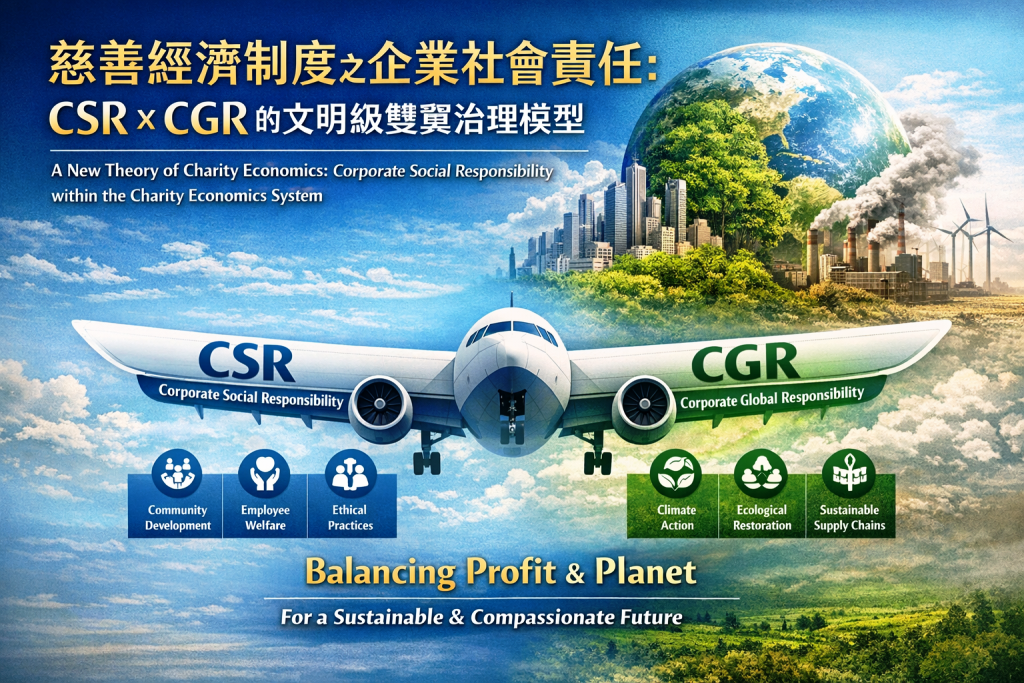
《慈善經濟主義新論》白皮書章節版本
Chapter X慈善經濟制度之企業社會責任:CSR × CGR 的文明級雙翼治理模型
A New Theory of Charity Economics: Corporate Social Responsibility within the Charity Economics System
創始人:陳俊吉 Frank Chen
學派定位:Civilizational Economic School(慈善經濟主義文明型經濟學派)
學派定位:Civilizational Economic School(慈善經濟主義文明型經濟學派)
用途:世代傳承、學派建構、制度設計、全球永續政策參考
21世紀全球經濟高速擴張,但資本主義體系下的企業成長邏輯,長期存在三大結構性缺陷:
外部成本轉嫁(Externalization of Costs)
生態責任缺位(Ecological Accountability Gap)
代際正義斷裂(Intergenerational Responsibility Failure)
企業財務報表可以盈利,但其生態足跡、碳排放、資源消耗、社會不平等成本卻未被完整內生化。
在此背景下,傳統企業社會責任(CSR)多停留於補償性公益,而未成為制度性責任內核。
二、理論核心:CSR × CGR 的雙翼文明治理架構
CSR(Corporate Social Responsibility)
→ 地域層級責任(Local-Societal Responsibility)
CGR(Corporate Global Responsibility)
→ 全球層級責任(Planetary-Civilizational Responsibility)
結構模型:
CGR(全球責任)
▲
│
─────────┼─────────
│
CSR(社會責任)
CSR 功能層級:
CSR 解決「社會公平」
CGR 解決「文明存亡」
 外部成本內生化機制
 綠色文明融資模型
傳統指標 文明指標
財務報表 綠色文明貢獻指數
還款能力 生命最大化效用係數
資產負債比 永續轉型能力
 生命最大化經濟觀
五、治理架構:四層責任整合模型
層級 主體 責任範圍
個人 創業家 綠色使命導向
企業 CSR 社會責任內生
全球 CGR 文明責任承擔
制度 政府 × 金融 資本流向重設
六、與傳統資本主義之比較
面向 傳統資本主義 慈善經濟主義
目標函數 利潤最大化 生命最大化
成本處理 外部化 內生化
融資邏輯 財務導向 文明導向
責任範圍 股東優先 文明優先
七、制度定位與學派意義
慈善經濟主義文明型經濟學派
企業責任內生化制度理論核心章節
CSR 是企業的道德起點
CGR 是企業的文明終點
慈善經濟主義新論:慈善經濟制度中的企業社會責任——實現全球性利他慈愛責任概念
慈善經濟主義(Charity Economicism)作為一種新型經濟學派,強調在經濟發展中融入全球利他與慈愛責任的核心概念。其學派層級定位為文明型經濟學派(Civilizational Economic School),旨在透過系統化的制度設計,促進人類本性的慈善利他特質與經濟活動的深度融合。創始人:陳俊吉(Frank Chen)。
在慈善經濟制度中,企業社會責任(Corporate Social Responsibility, CSR)與全球大企業責任(Corporate Global Responsibility, CGR)構成一體多元的互補架構,猶如飛機的雙翼,密不可分且相輔相成。此一互補機制能最大化慈善企業的條件優化,從而擴大人類在經濟發展中的利他本性。傳統經濟模式中,大小企業往往在快速擴張時忽略外部社會成本、對地球生存環境的完整責任,以及政府監管的不完善之處。慈善經濟主義正針對這些問題,提供解決方案。
在當今全球化企業環境下,唯有建立加速創業家的綠色環境永續與生命最大化概念,方能實現轉型。具體而言,銀行在融資中小企業(SMEs)時,不應僅依賴財務報表或還款能力評估,而應優先考量其對綠色地球永續的貢獻度。透過此一轉變,社會、國家、政府以及大中小企業將共同實現全球性利他慈愛與綠色永續責任的概念。這不僅能遏止當前地球生態污染與破壞的惡化趨勢,更能對當代及後代負起完整責任,從而降低地球面臨第六次或第七次大規模毀滅事件的機率與途徑。
慈善經濟主義不僅是經濟理論的創新,更是對人類文明永續發展的呼籲。它呼籲所有利益相關者重新定義經濟成功,將利他慈愛融入核心決策,以確保經濟增長與地球福祉的平衡。
英文版(English Version)
A New Theory of Charity Economicism: Corporate Social Responsibility in the Charity Economic System – Realizing the Concept of Global Altruistic and Compassionate Responsibility
Charity Economicism represents an innovative economic paradigm that integrates global altruism and compassionate responsibility into economic development. Classified under the Civilizational Economic School, it seeks to harmonize humanity's innate philanthropic traits with economic activities through structured institutional designs. Founder: Frank Chen.
Within the charity economic system, Corporate Social Responsibility (CSR) and Corporate Global Responsibility (CGR) form an integrated, multifaceted, and complementary framework, akin to the two wings of an aircraft—indivisible and mutually reinforcing. This synergy maximizes the optimization of conditions for philanthropic enterprises, thereby amplifying humanity's inherent altruistic nature in the context of economic growth. It directly addresses the shortcomings of conventional models, where large and small enterprises pursue rapid development without accounting for external social costs, assuming full responsibility for planetary survival, or benefiting from adequate governmental oversight.
In the era of modern globalized enterprises, establishing a concept of accelerated entrepreneurial green environmental sustainability and life maximization is essential. Specifically, when financing small and medium-sized enterprises (SMEs), banks should not solely rely on financial statements or repayment capacity but prioritize contributions to a green and sustainable planet. Through this shift, society, nations, governments, and enterprises of all sizes can collectively achieve a global altruistic, compassionate, green, and sustainable responsibility. This approach will mitigate the escalating ecological pollution and destruction of the Earth, ensuring accountability to current and future generations, and reducing the likelihood and pathways of a sixth or seventh planetary cataclysm.
Charity Economicism is not merely an economic innovation but a call to action for the sustainable advancement of human civilization. It urges all stakeholders to redefine economic success by embedding altruistic compassion into core decision-making, balancing growth with planetary well-being.