日期:2026/02/07 IAE
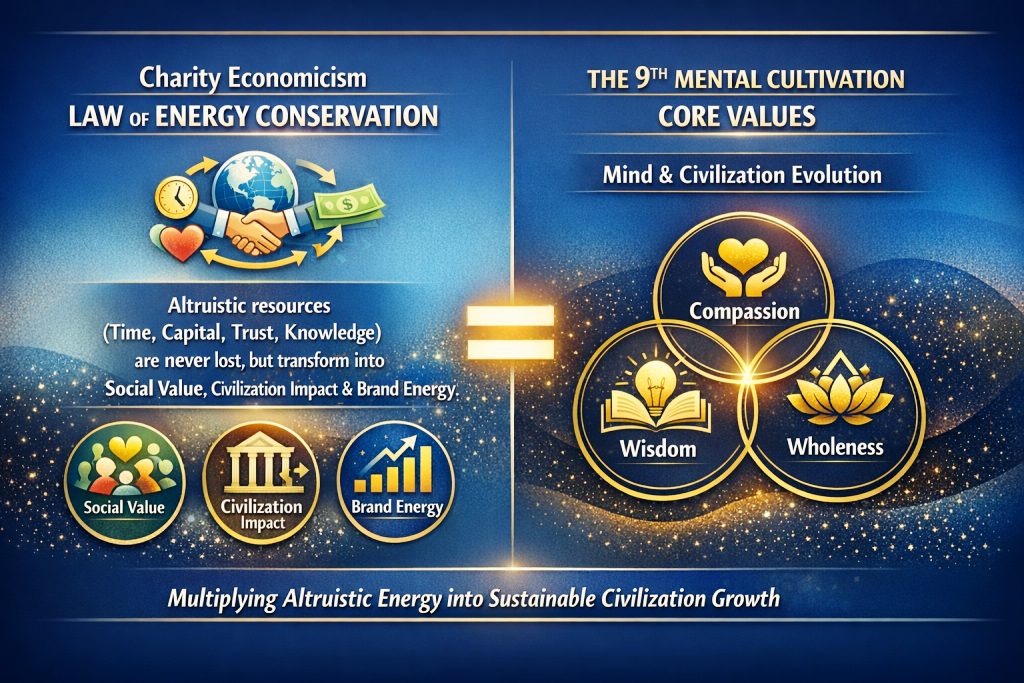
I. Formal Definition of the Core Proposition (School-Level)
1️⃣ Charity Economicism – Law of Energy Conservation
Formal Definition (Canonical Version):
Within the framework of Charity Economicism, the Law of Energy Conservation states that any form of altruistic input—including capital, time, institutional resources, governance effort, trust, and wisdom capital—does not disappear or become wasted. Instead, such input is inevitably transformed into other accumulative and transferable forms of value, including social value, civilizational capital, institutional credibility, and long-term brand energy.
This law affirms that altruistic economic energy follows a principle of conservation across time and systems: while its form may change, its total value is preserved and continuously reconstituted within the social and civilizational economy.
Key Theoretical Implications
-
Altruistic contributions are not costs, but energy transformations within a higher-dimensional economic system.
-
Value conversion may occur across non-financial domains, such as trust, legitimacy, social cohesion, and intergenerational responsibility.
-
The law operates on a long-term, systemic horizon, beyond short-term financial accounting.
Concise Citation Version (for papers / slides)
The Law of Energy Conservation in Charity Economicism holds that altruistic economic inputs are never lost; they are conserved and transformed into enduring social, civilizational, and institutional value.
Attribution (recommended academic format)
Frank Chen (陳俊吉)
Founder of the Global School of Charity Economicism
Charity Economicism – Selected Canon, 2026.02.07