日期:2025/12/23 IAE
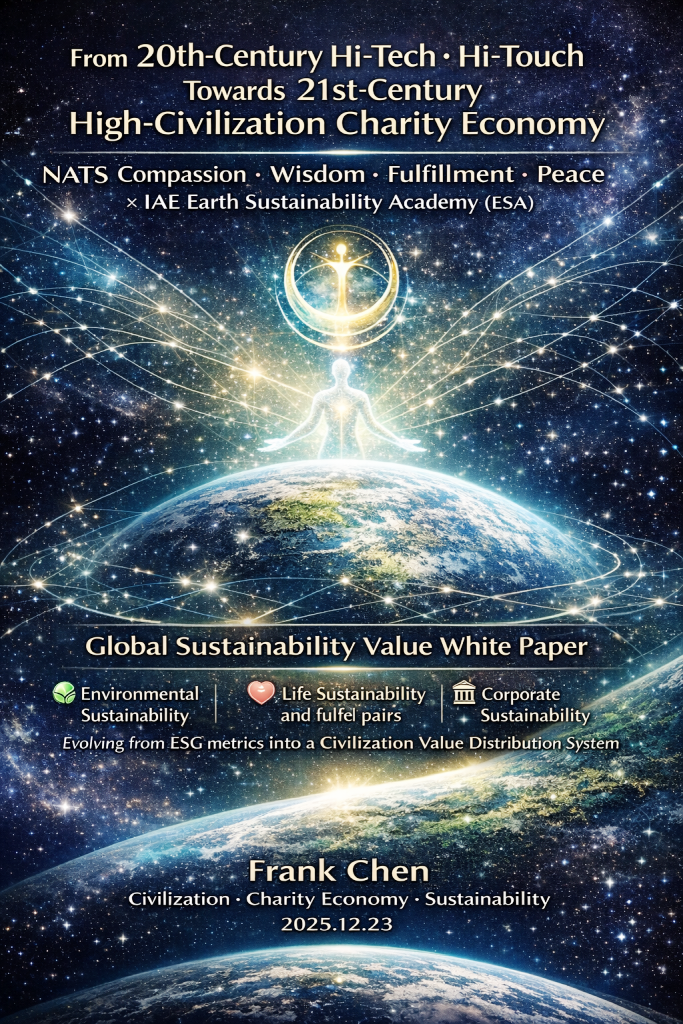
**From 20th-Century Hi-Tech · Hi-Touch
Toward a 21st-Century High-Civilization Charity Economy**
**— NATS Compassion · Wisdom · Fulfillment · Peace
× IAE Earth Sustainability Academy (ESA)**
A Global Value White Paper on Environmental, Life, and Corporate Sustainability
Author: Frank Chen
Date: December 23, 2025
I. The Civilizational Turning Point
From Hi-Tech · Hi-Touch to Hi-Civilization
At the end of the 20th century, humanity entered an era defined by Hi-Tech (high technology) and Hi-Touch (high cognition and emotional intelligence). Information technology, the internet, and artificial intelligence propelled productivity and knowledge expansion to unprecedented levels.
However, these advances were accompanied by profound systemic challenges:
-
Widening wealth inequality
-
Resource exploitation and environmental imbalance
-
Financial systems detached from life value
-
Technological acceleration without civilizational direction
The fundamental challenge of the 21st century is no longer whether technology is sufficient, but whether civilization is sufficient.
Accordingly, this White Paper proposes a decisive paradigm shift:
Humanity is transitioning from the Hi-Tech era into the Hi-Civilization era.
II. The Core Spiritual Architecture of the NATS Civilization-Based Charity Economy
NATS (National Asset & Token of Spiritual Civilization) is not merely a crypto-asset. It is a civilization-level value system, anchored in four inseparable civilizational principles:
1. Compassion
-
The ultimate purpose of an economy is not efficiency, but the reduction of human suffering
-
Reframing “profit maximization” as maximization of life value
2. Wisdom
3. Fulfillment
-
Corporations exist not only to generate shareholder returns, but to complete their social and civilizational roles
-
Individuals, enterprises, and societies form a positive, regenerative loop
4. Peace
NATS is the first economic model explicitly anchored in spiritual civilization as its value foundation.
III. The Charity Economy: A New Economic Paradigm for the 21st Century
1. From Capital Economy to Charity Economy
| 20th-Century Capital Economy |
21st-Century Charity Economy |
| Capital efficiency |
Life efficiency |
| Profit-driven |
Value-driven |
| Zero-sum competition |
Co-existence and co-prosperity |
| Financial metrics |
Civilizational metrics |
The charity economy is not a donation mechanism; it is an economic structure whose core design inherently embodies charitable purpose.
IV. Positioning of the IAE Earth Sustainability Academy (ESA)
The IAE Earth Sustainability Academy (ESA) serves as a civilization-level educational and institutional platform with three core missions:
(1) Civilizational Education Upgrade
-
From professional skill training to civilizational literacy education
-
Integrating sustainability, ethics, and life value into corporate and governmental decision models
(2) Institutional Design Laboratory
(3) Global Co-Creation Platform
-
Governments × Enterprises × NGOs × Academia × Youth
-
Forming cross-civilization, cross-religion, cross-economic-system collaboration networks
V. Integrated Global Sustainability Value Model
1. Environmental Sustainability
-
Environmental degradation recognized as civilizational debt
-
NATS positioned as a green civilization reserve unit
-
ESG evolving from disclosure compliance into a value allocation mechanism
2. Life Sustainability
-
Economic systems designed around life accessibility
-
Reducing life exclusion caused by pricing, institutional, or informational barriers
3. Corporate Sustainability
VI. A Governance Model of Inclusion · Co-Creation · Symbiosis
The governance principles proposed by NATS × IAE-ESA are:
-
Inclusion: Coexistence of diverse civilizations, religions, and systems
-
Co-Creation: Value generated collaboratively by all participants
-
Symbiosis: Growth models without structural losers
This represents a non-hegemonic, non-centralized, non-confrontational pathway to global governance.
VII. Conclusion: From Economic Instruments to Civilizational Carriers
The scarcest resource of the 21st century is no longer capital, technology, or energy, but:
Civilizational frameworks capable of carrying humanity’s shared future.
What NATS and the IAE Earth Sustainability Academy (ESA) represent is not a project, but a direction:
-
An economy no longer detached from life
-
Technology no longer divorced from civilization
-
Development no longer achieved at the expense of the future
Final Declaration
This is not a financial white paper. It is a civilizational proposal.
It is not designed to create wealth for a few, but to prevent irreversible costs for all of humanity.