日期:2026/02/06 IAE
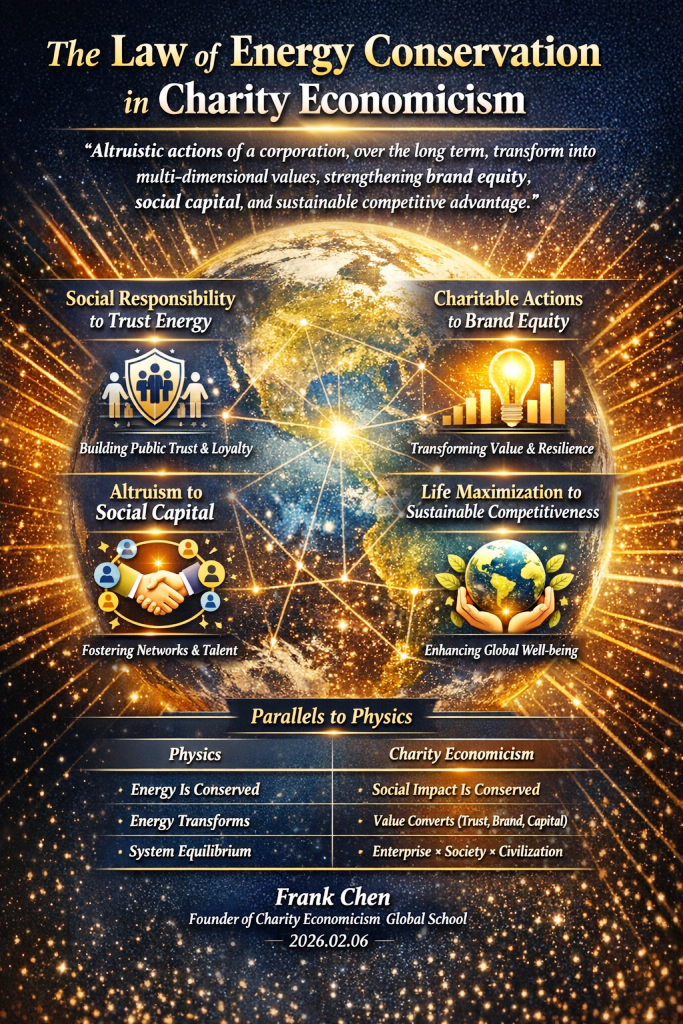
The Law of Energy Conservation in Charity Economicism
Frank Chen (陳俊吉)
Founder of Charity Economicism
February 6, 2026
I. Law Statement
The Law of Energy Conservation in Charity Economicism states that:
Altruistic and charitable economic actions undertaken by enterprises do not dissipate over time. Instead, the social and moral energy accumulated through such actions is conserved and transformed into multi-dimensional value returns, including brand equity, social capital, public trust, and sustainable competitive advantage.
This law explains a long-term, systemic value transformation mechanism between enterprises, society, and civilization.
II. Core Theoretical Framework
The Law of Energy Conservation in Charity Economicism is a cross-disciplinary principle integrating social science and life philosophy, and can be understood through four interrelated value-conversion dimensions:
1. Social Responsibility → Trust Energy Accumulation
When enterprises consistently engage in altruistic and socially responsible actions, they generate:
This trust energy gradually converts into market confidence, customer loyalty, and reputational resilience.
2. Charitable Actions → Multi-Dimensional Brand Equity
Charitable economic behavior should not be viewed as a cost, but as a long-term value investment.
Over time, accumulated altruistic actions transform into:
Thus forming a non-price-based competitive advantage that is difficult to replicate.
3. Altruism → Social Capital and Talent Advantage
Sustained altruistic behavior enables enterprises to build:
-
High-trust networks with governments, NGOs, and civil organizations
-
Strong relational capital
-
Long-term talent attraction and organizational cohesion
This represents the conservation and conversion of social capital energy within economic systems.
4. Life Maximization → Sustainable Competitiveness
From the perspective of life philosophy:
-
Charity Economicism prioritizes life value maximization over short-term profit maximization
-
Enterprises internalize social welfare, environmental responsibility, and civilizational sustainability
As a result, enterprises evolve from purely economic entities into active participants in civilizational progress.
III. Parallels with the Physical Law of Energy Conservation
| Physics |
Charity Economicism |
| Energy cannot be destroyed |
Social and moral energy does not disappear |
| Energy transforms |
Value transforms (trust, brand, capital) |
| System equilibrium |
Enterprise × Society × Civilization equilibrium |
IV. Theoretical Significance and Research Outlook
The Law of Energy Conservation in Charity Economicism demonstrates:
Future research may apply:
-
Brand equity quantification models
-
Social Return on Investment (SROI)
-
Long-term enterprise performance analysis
to further validate and operationalize the law.
V. Civilizational Conclusion
When charity is no longer perceived as a cost, but as conserved civilizational energy,
enterprises transcend profit-making roles and become key nodes in human civilizational evolution.
This is the fundamental meaning of
The Law of Energy Conservation in Charity Economicism.
✦ Author Attribution (Standard Citation)
Frank Chen (陳俊吉)
Founder of Charity Economicism
First proposed: February 6, 2026